yuraedcel28@gmail.com

yuraedcel28@gmail.com

How to Build an Explainable AI Analysis Pipeline Using SHAP-IQ to Understand Feature Importance, Interaction Effects, and Model Decision Breakdown

INSTANCE_I = int(np.clip(INSTANCE_I, 0, len(X_test)-1)) x = X_test.iloc[INSTANCE_I].values y_true = float(y_test.iloc[INSTANCE_I]) pred = float(model.predict([x])[0]) iv = explainer.explain(x, budget=int(BUDGET_LOCAL), random_state=0) baseline = float(getattr(iv, “baseline_value”, 0.0)) main_effects = extract_main_effects(iv, feature_names) pair_df = extract_pair_matrix(iv, feature_names) print(“\n” + “=”*90) print(“LOCAL EXPLANATION (single test instance)”)…

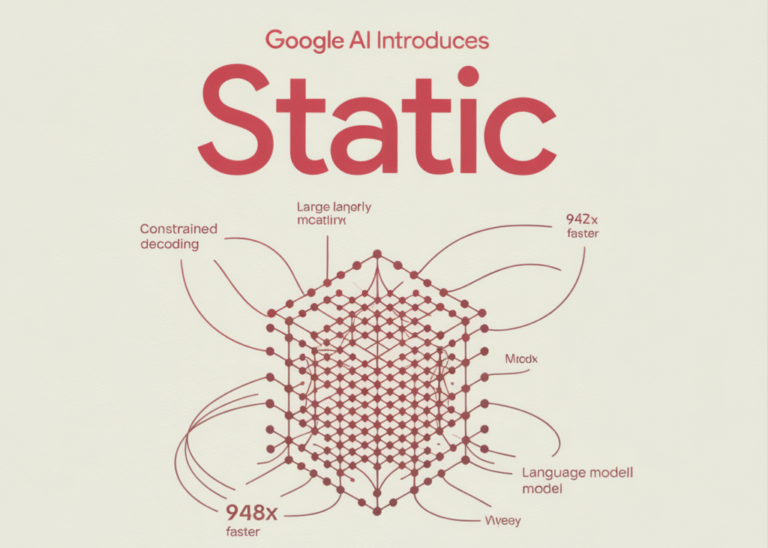
Google AI Introduces STATIC: A Sparse Matrix Framework Delivering 948x Faster Constrained Decoding for LLM Based Generative Retrieval

In industrial recommendation systems, the shift toward Generative Retrieval (GR) is replacing traditional embedding-based nearest neighbor search with Large Language Models (LLMs). These models represent items as Semantic IDs (SIDs)—discrete token sequences—and treat retrieval as an autoregressive decoding task. However,…

A Complete End-to-End Coding Guide to MLflow Experiment Tracking, Hyperparameter Optimization, Model Evaluation, and Live Model Deployment

best_C = best[“params”][“C”] best_solver = best[“params”][“solver”] final_pipe = Pipeline([ (“scaler”, StandardScaler()), (“clf”, LogisticRegression( C=best_C, solver=best_solver, penalty=”l2″, max_iter=2000, random_state=42 )) ]) with mlflow.start_run(run_name=”final_model_run”) as final_run: final_pipe.fit(X_train, y_train) proba = final_pipe.predict_proba(X_test)[:, 1] pred = (proba >= 0.5).astype(int) metrics = { “test_auc”: float(roc_auc_score(y_test,…

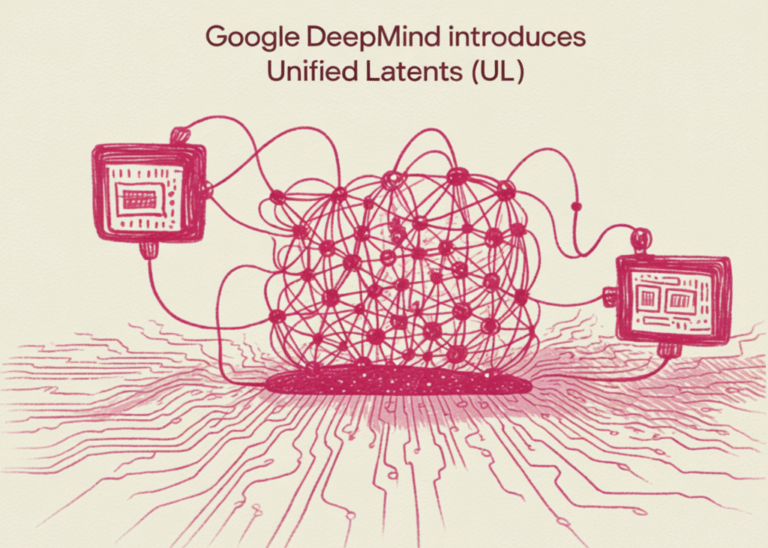
Google DeepMind Introduces Unified Latents (UL): A Machine Learning Framework that Jointly Regularizes Latents Using a Diffusion Prior and Decoder

Generative AI’s current trajectory relies heavily on Latent Diffusion Models (LDMs) to manage the computational cost of high-resolution synthesis. By compressing data into a lower-dimensional latent space, models can scale effectively. However, a fundamental trade-off persists: lower information density makes…

A Coding Implementation to Build a Hierarchical Planner AI Agent Using Open-Source LLMs with Tool Execution and Structured Multi-Agent Reasoning

def executor_agent(step: Dict[str, Any], context: Dict[str, Any]) -> StepResult: step_id = int(step.get(“id”, 0)) title = step.get(“title”, f”Step {step_id}”) tool = step.get(“tool”, “llm”) ctx_compact = { “goal”: context.get(“goal”), “assumptions”: context.get(“assumptions”, []), “prior_results”: [ {“step_id”: r.step_id, “title”: r.title, “tool”: r.tool, “output”: r.output[:1500]}…