Latest News

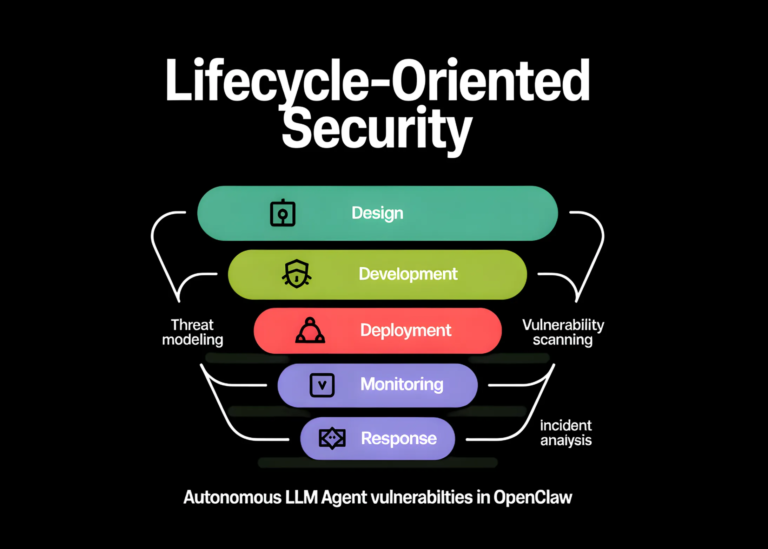
Tsinghua and Ant Group Researchers Unveil a Five-Layer Lifecycle-Oriented Security Framework to Mitigate Autonomous LLM Agent Vulnerabilities in OpenClaw

Autonomous LLM agents like OpenClaw are shifting the paradigm from passive assistants to proactive entities capable of executing complex, long-horizon tasks through high-privilege system access. However, a security analysis research report from Tsinghua University and Ant Group reveals that OpenClaw’s…

Read MoreTsinghua and Ant Group Researchers Unveil a Five-Layer Lifecycle-Oriented Security Framework to Mitigate Autonomous LLM Agent Vulnerabilities in OpenClaw

Baidu Qianfan Team Releases Qianfan-OCR: A 4B-Parameter Unified Document Intelligence Model

The Baidu Qianfan Team introduced Qianfan-OCR, a 4B-parameter end-to-end model designed to unify document parsing, layout analysis, and document understanding within a single vision-language architecture. Unlike traditional multi-stage OCR pipelines that chain separate modules for…

Read MoreBaidu Qianfan Team Releases Qianfan-OCR: A 4B-Parameter Unified Document Intelligence Model

NVIDIA AI Open-Sources ‘OpenShell’: A Secure Runtime Environment for Autonomous AI Agents

The deployment of autonomous AI agents—systems capable of using tools and executing code—presents a unique security challenge. While standard LLM applications are restricted to text-based interactions, autonomous agents require access to shell environments, file systems, and network endpoints to perform…

Read MoreNVIDIA AI Open-Sources ‘OpenShell’: A Secure Runtime Environment for Autonomous AI Agents

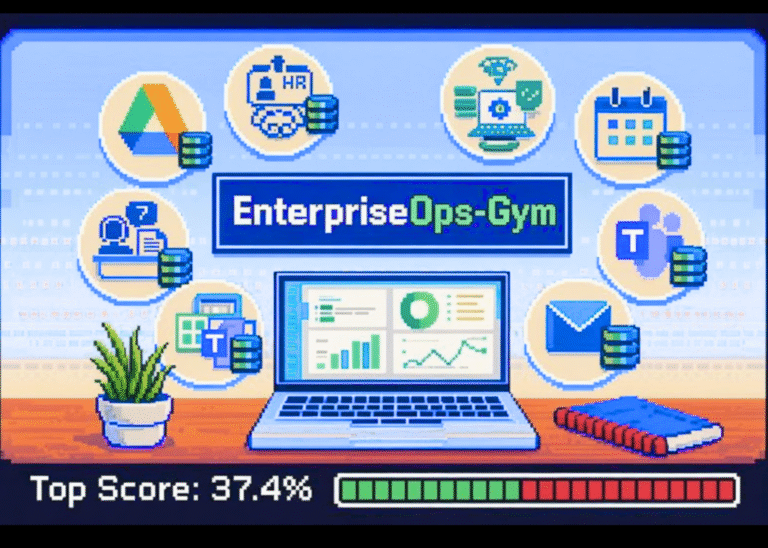
ServiceNow Research Introduces EnterpriseOps-Gym: A High-Fidelity Benchmark Designed to Evaluate Agentic Planning in Realistic Enterprise Settings

Large language models (LLMs) are transitioning from conversational to autonomous agents capable of executing complex professional workflows. However, their deployment in enterprise environments remains limited by the lack of benchmarks that capture the specific challenges of professional settings: long-horizon planning,…

Read MoreServiceNow Research Introduces EnterpriseOps-Gym: A High-Fidelity Benchmark Designed to Evaluate Agentic Planning in Realistic Enterprise Settings

Unsloth AI Releases Unsloth Studio: A Local No-Code Interface For High-Performance LLM Fine-Tuning With 70% Less VRAM Usage

The transition from a raw dataset to a fine-tuned Large Language Model (LLM) traditionally involves significant infrastructure overhead, including CUDA environment management and high VRAM requirements. Unsloth AI, known for its high-performance training library, has released Unsloth Studio to address…

Read MoreUnsloth AI Releases Unsloth Studio: A Local No-Code Interface For High-Performance LLM Fine-Tuning With 70% Less VRAM Usage

Google AI Releases WAXAL: A Multilingual African Speech Dataset for Training Automatic Speech Recognition and Text-to-Speech Models

Speech technology still has a data distribution problem. Automatic Speech Recognition (ASR) and Text-to-Speech (TTS) systems have improved rapidly for high-resource languages, but many African languages remain poorly represented in open corpora. A team of researchers from Google and other…

Read MoreGoogle AI Releases WAXAL: A Multilingual African Speech Dataset for Training Automatic Speech Recognition and Text-to-Speech Models

How to Build High-Performance GPU-Accelerated Simulations and Differentiable Physics Workflows Using NVIDIA Warp Kernels

angles = np.linspace(0.0, 2.0 * np.pi, n_particles, endpoint=False, dtype=np.float32) px0_np = 0.4 * np.cos(angles).astype(np.float32) py0_np = (0.7 + 0.15 * np.sin(angles)).astype(np.float32) vx0_np = (-0.8 * np.sin(angles)).astype(np.float32) vy0_np = (0.8 * np.cos(angles)).astype(np.float32) px0_wp = wp.array(px0_np, dtype=wp.float32, device=device) py0_wp = wp.array(py0_np, dtype=wp.float32,…

Read MoreHow to Build High-Performance GPU-Accelerated Simulations and Differentiable Physics Workflows Using NVIDIA Warp Kernels

Mistral AI Releases Mistral Small 4: A 119B-Parameter MoE Model that Unifies Instruct, Reasoning, and Multimodal Workloads

Mistral AI has released Mistral Small 4, a new model in the Mistral Small family designed to consolidate several previously separate capabilities into a single deployment target. Mistral team describes Small 4 as its first model to combine the roles…

Read MoreMistral AI Releases Mistral Small 4: A 119B-Parameter MoE Model that Unifies Instruct, Reasoning, and Multimodal Workloads