Latest News

A Coding Guide to Design and Orchestrate Advanced ReAct-Based Multi-Agent Workflows with AgentScope and OpenAI
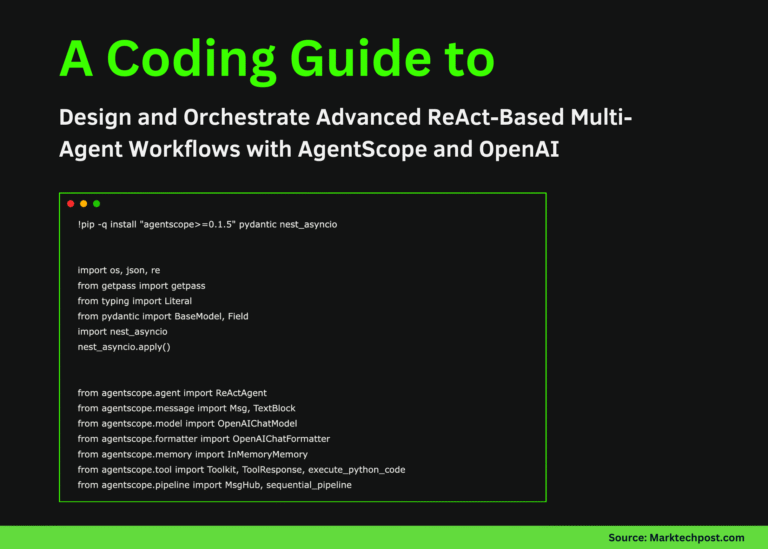
In this tutorial, we build an advanced multi-agent incident response system using AgentScope. We orchestrate multiple ReAct agents, each with a clearly defined role such as routing, triage, analysis, writing, and review, and connect them through structured routing and a…
Read MoreA Coding Guide to Design and Orchestrate Advanced ReAct-Based Multi-Agent Workflows with AgentScope and OpenAI

LLM-Pruning Collection: A JAX Based Repo For Structured And Unstructured LLM Compression

Zlab Princeton researchers have released LLM-Pruning Collection, a JAX based repository that consolidates major pruning algorithms for large language models into a single, reproducible framework. It targets one concrete goal, make it easy to compare block level, layer level and…

Read MoreLLM-Pruning Collection: A JAX Based Repo For Structured And Unstructured LLM Compression

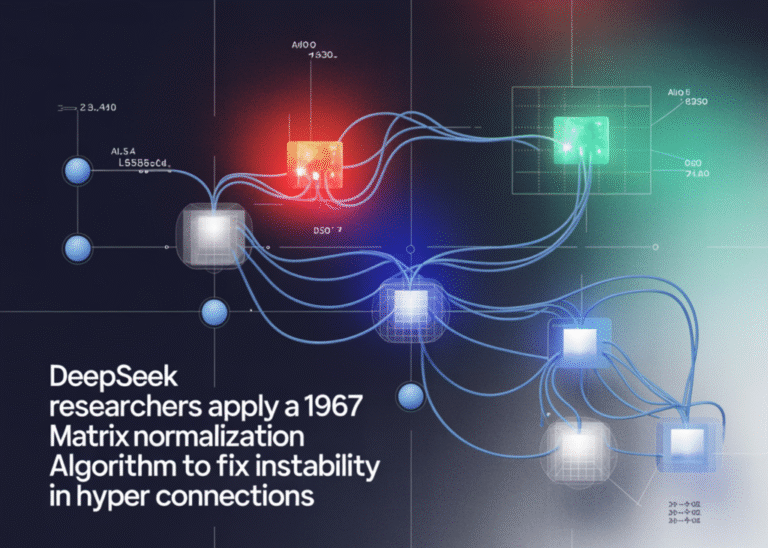
DeepSeek Researchers Apply a 1967 Matrix Normalization Algorithm to Fix Instability in Hyper Connections

DeepSeek researchers are trying to solve a precise issue in large language model training. Residual connections made very deep networks trainable, hyper connections widened that residual stream, and training then became unstable at scale. The new method mHC, Manifold Constrained…

Read MoreDeepSeek Researchers Apply a 1967 Matrix Normalization Algorithm to Fix Instability in Hyper Connections

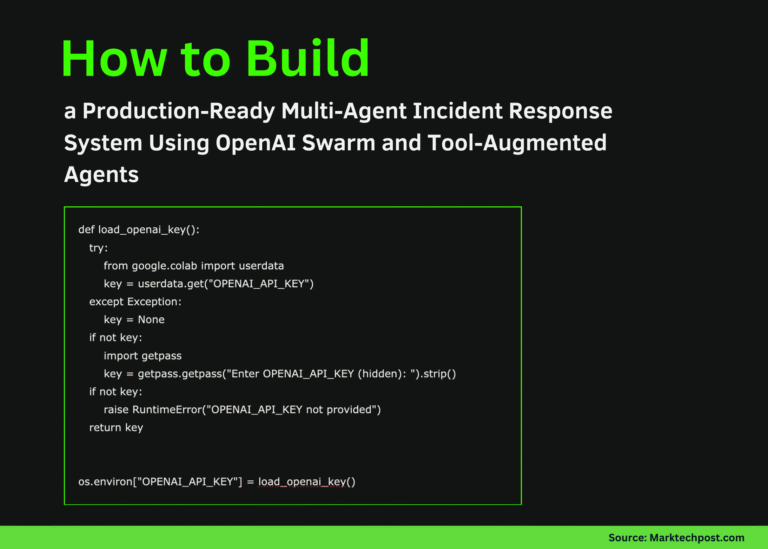
How to Build a Production-Ready Multi-Agent Incident Response System Using OpenAI Swarm and Tool-Augmented Agents

In this tutorial, we build an advanced yet practical multi-agent system using OpenAI Swarm that runs in Colab. We demonstrate how we can orchestrate specialized agents, such as a triage agent, an SRE agent, a communications agent, and a critic,…

Read MoreHow to Build a Production-Ready Multi-Agent Incident Response System Using OpenAI Swarm and Tool-Augmented Agents

Recursive Language Models (RLMs): From MIT’s Blueprint to Prime Intellect’s RLMEnv for Long Horizon LLM Agents

Recursive Language Models aim to break the usual trade off between context length, accuracy and cost in large language models. Instead of forcing a model to read a giant prompt in one pass, RLMs treat the prompt as an external…

Read MoreRecursive Language Models (RLMs): From MIT’s Blueprint to Prime Intellect’s RLMEnv for Long Horizon LLM Agents

A Coding Implementation to Build a Self-Testing Agentic AI System Using Strands to Red-Team Tool-Using Agents and Enforce Safety at Runtime

In this tutorial, we build an advanced red-team evaluation harness using Strands Agents to stress-test a tool-using AI system against prompt-injection and tool-misuse attacks. We treat agent safety as a first-class engineering problem by orchestrating multiple agents that generate adversarial…

Read MoreA Coding Implementation to Build a Self-Testing Agentic AI System Using Strands to Red-Team Tool-Using Agents and Enforce Safety at Runtime

How Cloudflare’s tokio-quiche Makes QUIC and HTTP/3 a First Class Citizen in Rust Backends

Cloudflare has open sourced tokio-quiche, an asynchronous QUIC and HTTP/3 Rust library that wraps its battle tested quiche implementation with the Tokio runtime. The library has been refined inside production systems such as Apple iCloud Private Relay, next generation Oxy…

Read MoreHow Cloudflare’s tokio-quiche Makes QUIC and HTTP/3 a First Class Citizen in Rust Backends

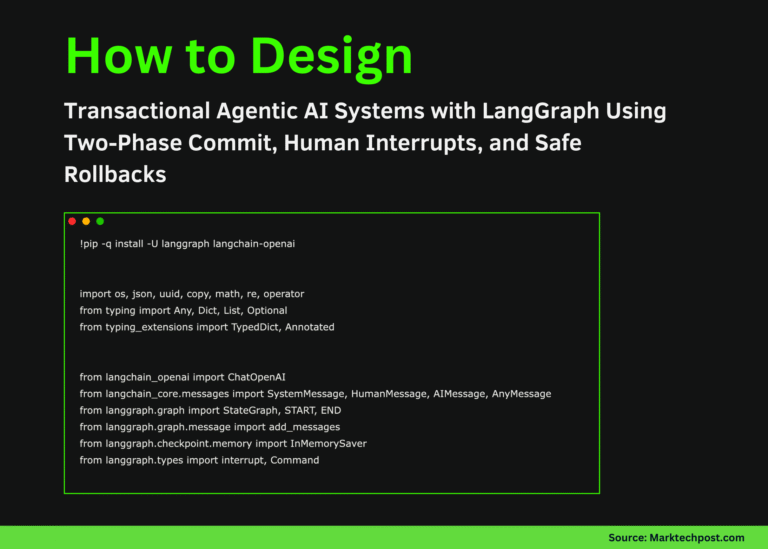
How to Design Transactional Agentic AI Systems with LangGraph Using Two-Phase Commit, Human Interrupts, and Safe Rollbacks

In this tutorial, we implement an agentic AI pattern using LangGraph that treats reasoning and action as a transactional workflow rather than a single-shot decision. We model a two-phase commit system in which an agent stages reversible changes, validates strict…

Read MoreHow to Design Transactional Agentic AI Systems with LangGraph Using Two-Phase Commit, Human Interrupts, and Safe Rollbacks

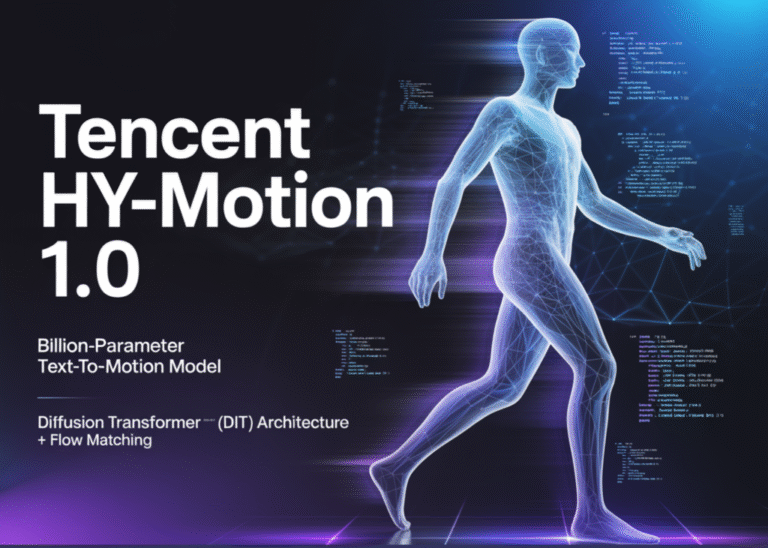
Tencent Released Tencent HY-Motion 1.0: A Billion-Parameter Text-to-Motion Model Built on the Diffusion Transformer (DiT) Architecture and Flow Matching

Tencent Hunyuan’s 3D Digital Human team has released HY-Motion 1.0, an open weight text-to-3D human motion generation family that scales Diffusion Transformer based Flow Matching to 1B parameters in the motion domain. The models turn natural language prompts plus an…

Read MoreTencent Released Tencent HY-Motion 1.0: A Billion-Parameter Text-to-Motion Model Built on the Diffusion Transformer (DiT) Architecture and Flow Matching