Latest News

ALPHAONE: A Universal Test-Time Framework for Modulating Reasoning in AI Models

Large reasoning models, often powered by large language models, are increasingly used to solve high-level problems in mathematics, scientific analysis, and code generation. The central idea is to simulate two types of cognition: rapid responses for simpler reasoning and deliberate,…

Read MoreALPHAONE: A Universal Test-Time Framework for Modulating Reasoning in AI Models

How to Create Smart Multi-Agent Workflows Using the Mistral Agents API’s Handoffs Feature

In this tutorial, we’ll explore how to create smart, multi-agent workflows using the Mistral Agents API’s Handoffs feature. This lets different agents work together by passing tasks to each other, enabling complex problems to be solved in a modular and…

Read MoreHow to Create Smart Multi-Agent Workflows Using the Mistral Agents API’s Handoffs Feature

High-Entropy Token Selection in Reinforcement Learning with Verifiable Rewards (RLVR) Improves Accuracy and Reduces Training Cost for LLMs

Large Language Models (LLMs) generate step-by-step responses known as Chain-of-Thoughts (CoTs), where each token contributes to a coherent and logical narrative. To improve the quality of reasoning, various reinforcement learning techniques have been employed. These methods allow the model to…

Read MoreHigh-Entropy Token Selection in Reinforcement Learning with Verifiable Rewards (RLVR) Improves Accuracy and Reduces Training Cost for LLMs

Google Introduces Open-Source Full-Stack AI Agent Stack Using Gemini 2.5 and LangGraph for Multi-Step Web Search, Reflection, and Synthesis

Introduction: The Need for Dynamic AI Research Assistants Conversational AI has rapidly evolved beyond basic chatbot frameworks. However, most large language models (LLMs) still suffer from a critical limitation—they generate responses based only on static training data, lacking the ability…

Read MoreGoogle Introduces Open-Source Full-Stack AI Agent Stack Using Gemini 2.5 and LangGraph for Multi-Step Web Search, Reflection, and Synthesis

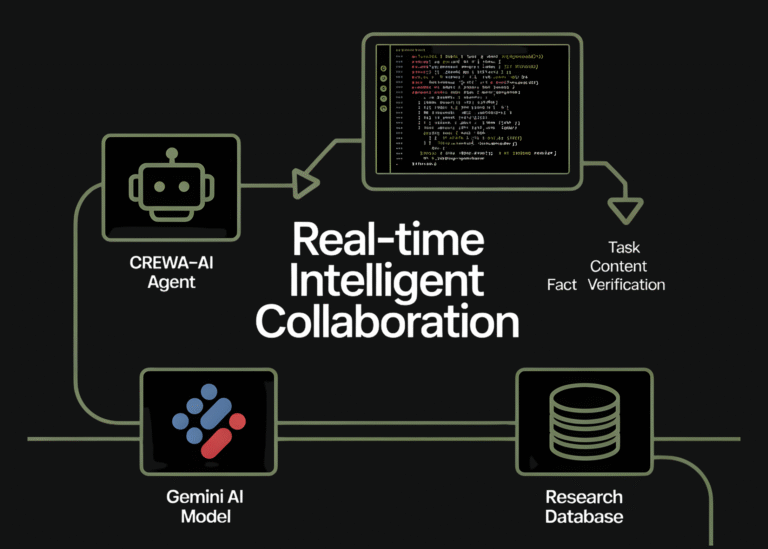
How to Build an Asynchronous AI Agent Network Using Gemini for Research, Analysis, and Validation Tasks

In this tutorial, we introduce the Gemini Agent Network Protocol, a powerful and flexible framework designed to enable intelligent collaboration among specialized AI agents. Leveraging Google’s Gemini models, the protocol facilitates dynamic communication between agents, each equipped with distinct roles:…

Read MoreHow to Build an Asynchronous AI Agent Network Using Gemini for Research, Analysis, and Validation Tasks

How to Enable Function Calling in Mistral Agents Using the Standard JSON Schema Format

In this tutorial, we’ll demonstrate how to enable function calling in Mistral Agents using the standard JSON schema format. By defining your function’s input parameters with a clear schema, you can make your custom tools seamlessly callable by the agent—enabling…

Read MoreHow to Enable Function Calling in Mistral Agents Using the Standard JSON Schema Format

Meet BioReason: The World’s First Reasoning Model in Biology that Enables AI to Reason about Genomics like a Biology Expert

A major hurdle in using AI for genomics is the lack of interpretable, step-by-step reasoning from complex DNA data. While DNA foundation models excel at learning rich sequence patterns for tasks such as variant prediction and gene regulation, they often…

Read MoreMeet BioReason: The World’s First Reasoning Model in Biology that Enables AI to Reason about Genomics like a Biology Expert

Google AI Introduces Multi-Agent System Search MASS: A New AI Agent Optimization Framework for Better Prompts and Topologies

Multi-agent systems are becoming a critical development in artificial intelligence due to their ability to coordinate multiple large language models (LLMs) to solve complex problems. Instead of relying on a single model’s perspective, these systems distribute roles among agents, each…

Read MoreGoogle AI Introduces Multi-Agent System Search MASS: A New AI Agent Optimization Framework for Better Prompts and Topologies

ByteDance Researchers Introduce DetailFlow: A 1D Coarse-to-Fine Autoregressive Framework for Faster, Token-Efficient Image Generation

Autoregressive image generation has been shaped by advances in sequential modeling, originally seen in natural language processing. This field focuses on generating images one token at a time, similar to how sentences are constructed in language models. The appeal of…

Read MoreByteDance Researchers Introduce DetailFlow: A 1D Coarse-to-Fine Autoregressive Framework for Faster, Token-Efficient Image Generation