Latest News

A Coding Implementation for Creating, Annotating, and Visualizing Complex Biological Knowledge Graphs Using PyBEL

In this tutorial, we explore how to leverage the PyBEL ecosystem to construct and analyze rich biological knowledge graphs directly within Google Colab. We begin by installing all necessary packages, including PyBEL, NetworkX, Matplotlib, Seaborn, and Pandas. We then demonstrate…

Read MoreA Coding Implementation for Creating, Annotating, and Visualizing Complex Biological Knowledge Graphs Using PyBEL

ByteDance Researchers Introduce ProtoReasoning: Enhancing LLM Generalization via Logic-Based Prototypes

Why Cross-Domain Reasoning Matters in Large Language Models (LLMs) Recent breakthroughs in LRMs, especially those trained using Long CoT techniques, show they can generalize impressively across different domains. Interestingly, models trained on tasks such as math or coding often perform…

Read MoreByteDance Researchers Introduce ProtoReasoning: Enhancing LLM Generalization via Logic-Based Prototypes

CMU Researchers Introduce Go-Browse: A Graph-Based Framework for Scalable Web Agent Training

Why Web Agents Struggle with Dynamic Web Interfaces Digital agents designed for web environments aim to automate tasks such as navigating pages, clicking buttons, or submitting forms. These agents operate by interpreting browser data and simulating user interactions to complete…

Read MoreCMU Researchers Introduce Go-Browse: A Graph-Based Framework for Scalable Web Agent Training

Build a Groundedness Verification Tool Using Upstage API and LangChain

Upstage’s Groundedness Check service provides a powerful API for verifying that AI-generated responses are firmly anchored in reliable source material. By submitting context–answer pairs to the Upstage endpoint, we can instantly determine whether the supplied context supports a given answer…

Read MoreBuild a Groundedness Verification Tool Using Upstage API and LangChain

Getting Started with Microsoft’s Presidio: A Step-by-Step Guide to Detecting and Anonymizing Personally Identifiable Information PII in Text

In this tutorial, we will explore how to use Microsoft’s Presidio, an open-source framework designed for detecting, analyzing, and anonymizing personally identifiable information (PII) in free-form text. Built on top of the efficient spaCy NLP library, Presidio is both lightweight…

Read MoreGetting Started with Microsoft’s Presidio: A Step-by-Step Guide to Detecting and Anonymizing Personally Identifiable Information PII in Text

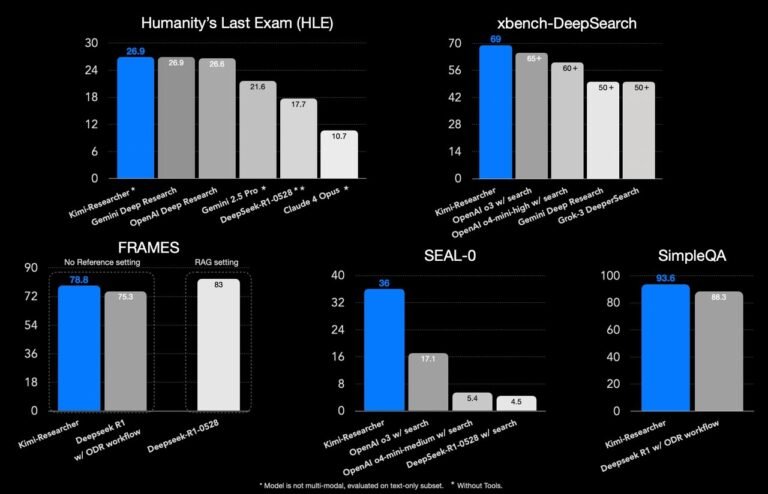
Moonshot AI Unveils Kimi-Researcher: An Reinforcement Learning RL-Trained Agent for Complex Reasoning and Web-Scale Search

The Challenge: Scaling Autonomous Agents with RL Autonomous AI agents have been at the forefront of taking computational abilities to various real-world tasks, and reinforcement learning (RL) is the key approach in agent creation. RL involves helping computational agents learn…

Read MoreMoonshot AI Unveils Kimi-Researcher: An Reinforcement Learning RL-Trained Agent for Complex Reasoning and Web-Scale Search

Sakana AI Introduces Reinforcement-Learned Teachers (RLTs): Efficiently Distilling Reasoning in LLMs Using Small-Scale Reinforcement Learning

Sakana AI introduces a novel framework for reasoning language models (LLMs) with a focus on efficiency and reusability: Reinforcement-Learned Teachers (RLTs). Traditional reinforcement learning (RL) approaches in LLMs are plagued by sparse reward signals and prohibitively high computational demands. By…

Read MoreSakana AI Introduces Reinforcement-Learned Teachers (RLTs): Efficiently Distilling Reasoning in LLMs Using Small-Scale Reinforcement Learning

A Coding Guide to Build a Production-Ready Asynchronous Python SDK with Rate Limiting, In-Memory Caching, and Authentication

In this tutorial, we guide users through building a robust, production-ready Python SDK. It begins by showing how to install and configure essential asynchronous HTTP libraries (aiohttp, nest-asyncio). It then walks through the implementation of core components, including structured response…

Read MoreA Coding Guide to Build a Production-Ready Asynchronous Python SDK with Rate Limiting, In-Memory Caching, and Authentication

New AI Framework Evaluates Where AI Should Automate vs. Augment Jobs, Says Stanford Study

Redefining Job Execution with AI Agents AI agents are reshaping how jobs are performed by offering tools that execute complex, goal-directed tasks. Unlike static algorithms, these agents combine multi-step planning with software tools to handle entire workflows across various sectors,…

Read MoreNew AI Framework Evaluates Where AI Should Automate vs. Augment Jobs, Says Stanford Study