Latest News

A Step-by-Step Implementation Tutorial for Building Modular AI Workflows Using Anthropic’s Claude Sonnet 3.7 through API and LangGraph
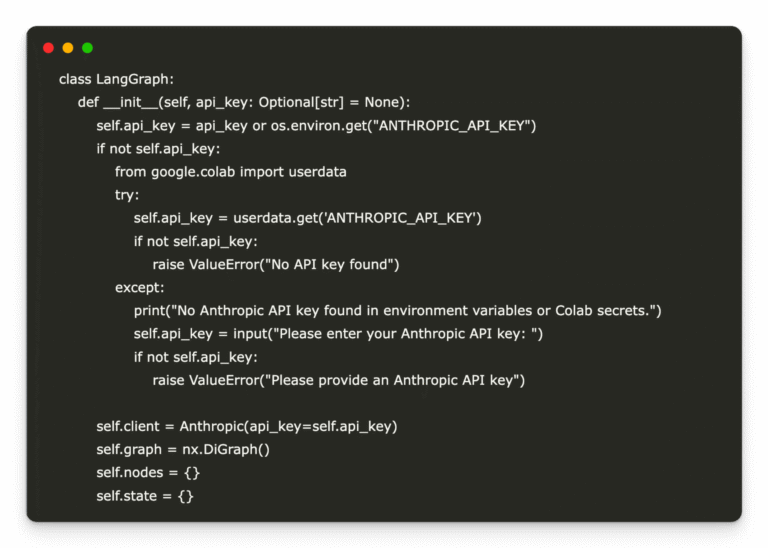
In this tutorial, we provide a practical guide for implementing LangGraph, a streamlined, graph-based AI orchestration framework, integrated seamlessly with Anthropic’s Claude API. Through detailed, executable code optimized for Google Colab, developers learn how to build and visualize AI workflows…

Read MoreA Step-by-Step Implementation Tutorial for Building Modular AI Workflows Using Anthropic’s Claude Sonnet 3.7 through API and LangGraph

Meta Researchers Introduced J1: A Reinforcement Learning Framework That Trains Language Models to Judge With Reasoned Consistency and Minimal Data

Large language models are now being used for evaluation and judgment tasks, extending beyond their traditional role of text generation. This has led to “LLM-as-a-Judge,” where models assess outputs from other language models. Such evaluations are essential in reinforcement learning…

Read MoreMeta Researchers Introduced J1: A Reinforcement Learning Framework That Trains Language Models to Judge With Reasoned Consistency and Minimal Data

Sampling Without Data is Now Scalable: Meta AI Releases Adjoint Sampling for Reward-Driven Generative Modeling

Data Scarcity in Generative Modeling Generative models traditionally rely on large, high-quality datasets to produce samples that replicate the underlying data distribution. However, in fields like molecular modeling or physics-based inference, acquiring such data can be computationally infeasible or even…

Read MoreSampling Without Data is Now Scalable: Meta AI Releases Adjoint Sampling for Reward-Driven Generative Modeling

Google AI Releases MedGemma: An Open Suite of Models Trained for Performance on Medical Text and Image Comprehension

At Google I/O 2025, Google introduced MedGemma, an open suite of models designed for multimodal medical text and image comprehension. Built on the Gemma 3 architecture, MedGemma aims to provide developers with a robust foundation for creating healthcare applications that…

Read MoreGoogle AI Releases MedGemma: An Open Suite of Models Trained for Performance on Medical Text and Image Comprehension

NVIDIA Releases Cosmos-Reason1: A Suite of AI Models Advancing Physical Common Sense and Embodied Reasoning in Real-World Environments

AI has advanced in language processing, mathematics, and code generation, but extending these capabilities to physical environments remains challenging. Physical AI seeks to close this gap by developing systems that perceive, understand, and act in dynamic, real-world settings. Unlike conventional…

Read MoreNVIDIA Releases Cosmos-Reason1: A Suite of AI Models Advancing Physical Common Sense and Embodied Reasoning in Real-World Environments

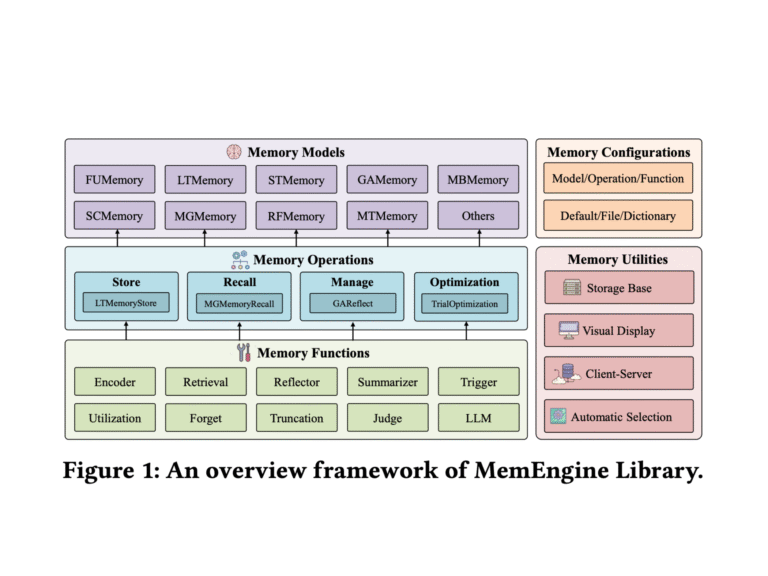
Researchers from Renmin University and Huawei Propose MemEngine: A Unified Modular AI Library for Customizing Memory in LLM-Based Agents

LLM-based agents are increasingly used across various applications because they handle complex tasks and assume multiple roles. A key component of these agents is memory, which stores and recalls information, reflects on past knowledge, and makes informed decisions. Memory plays…

Read MoreResearchers from Renmin University and Huawei Propose MemEngine: A Unified Modular AI Library for Customizing Memory in LLM-Based Agents

Enhancing Language Model Generalization: Bridging the Gap Between In-Context Learning and Fine-Tuning

Language models (LMs) have great capabilities as in-context learners when pretrained on vast internet text corpora, allowing them to generalize effectively from just a few task examples. However, fine-tuning these models for downstream tasks presents significant challenges. While fine-tuning requires…

Read MoreEnhancing Language Model Generalization: Bridging the Gap Between In-Context Learning and Fine-Tuning

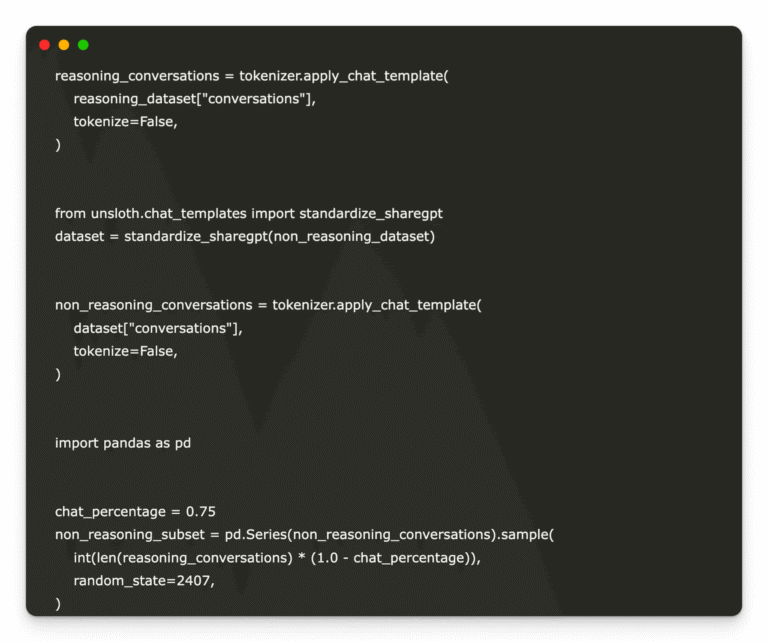
A Step-by-Step Coding Guide to Efficiently Fine-Tune Qwen3-14B Using Unsloth AI on Google Colab with Mixed Datasets and LoRA Optimization

Fine-tuning LLMs often requires extensive resources, time, and memory, challenges that can hinder rapid experimentation and deployment. Unsloth AI revolutionizes this process by enabling fast, efficient fine-tuning state-of-the-art models like Qwen3-14B with minimal GPU memory, leveraging advanced techniques such as…

Read MoreA Step-by-Step Coding Guide to Efficiently Fine-Tune Qwen3-14B Using Unsloth AI on Google Colab with Mixed Datasets and LoRA Optimization

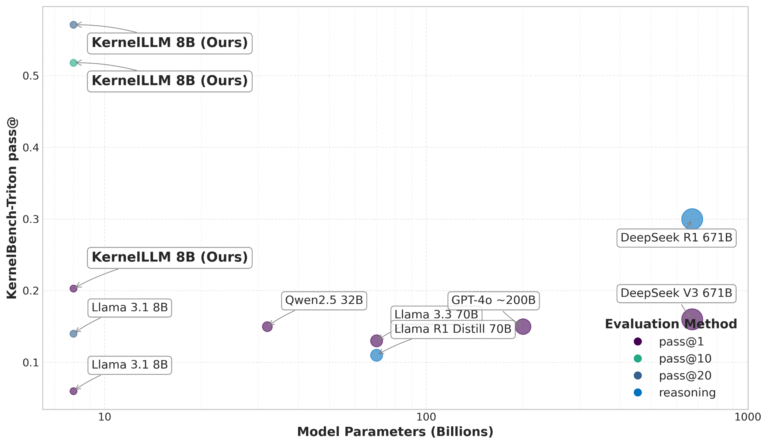
Meta Introduces KernelLLM: An 8B LLM that Translates PyTorch Modules into Efficient Triton GPU Kernels

Meta has introduced KernelLLM, an 8-billion-parameter language model fine-tuned from Llama 3.1 Instruct, aimed at automating the translation of PyTorch modules into efficient Triton GPU kernels. This initiative seeks to lower the barriers to GPU programming by simplifying kernel development…

Read MoreMeta Introduces KernelLLM: An 8B LLM that Translates PyTorch Modules into Efficient Triton GPU Kernels