Latest News

Vision Foundation Models: Implementation and Business Applications

from transformers import Blip2Processor, Blip2ForConditionalGeneration import torch from PIL import Image import requests import matplotlib.pyplot as plt import numpy as np from io import BytesIO # Load BLIP-2 model processor = Blip2Processor.from_pretrained(“Salesforce”) model = Blip2ForConditionalGeneration.from_pretrained(“Salesforce”, torch_dtype=torch.float16) if torch.cuda.is_available(): model =…

Read MoreVision Foundation Models: Implementation and Business Applications

LLMs Can Learn Complex Math from Just One Example: Researchers from University of Washington, Microsoft, and USC Unlock the Power of 1-Shot Reinforcement Learning with Verifiable Reward

Recent advancements in LLMs such as OpenAI-o1, DeepSeek-R1, and Kimi-1.5 have significantly improved their performance on complex mathematical reasoning tasks. Reinforcement Learning with Verifiable Reward (RLVR) is a key contributor to these improvements, which uses rule-based rewards, typically a binary…

Read MoreLLMs Can Learn Complex Math from Just One Example: Researchers from University of Washington, Microsoft, and USC Unlock the Power of 1-Shot Reinforcement Learning with Verifiable Reward

LLMs Can Now Reason in Parallel: UC Berkeley and UCSF Researchers Introduce Adaptive Parallel Reasoning to Scale Inference Efficiently Without Exceeding Context Windows

Large language models (LLMs) have made significant strides in reasoning capabilities, exemplified by breakthrough systems like OpenAI o1 and DeepSeekR1, which utilize test-time compute for search and reinforcement learning to optimize performance. Despite this progress, current methodologies face critical challenges…

Read MoreLLMs Can Now Reason in Parallel: UC Berkeley and UCSF Researchers Introduce Adaptive Parallel Reasoning to Scale Inference Efficiently Without Exceeding Context Windows

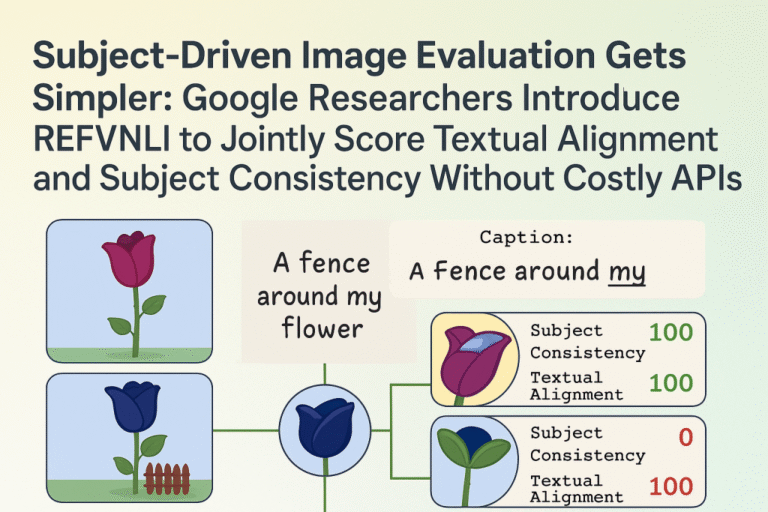
Subject-Driven Image Evaluation Gets Simpler: Google Researchers Introduce REFVNLI to Jointly Score Textual Alignment and Subject Consistency Without Costly APIs

Text-to-image (T2I) generation has evolved to include subject-driven approaches, which enhance standard T2I models by incorporating reference images alongside text prompts. This advancement allows for more precise subject representation in generated images. Despite the promising applications, subject-driven T2I generation faces…

Read MoreSubject-Driven Image Evaluation Gets Simpler: Google Researchers Introduce REFVNLI to Jointly Score Textual Alignment and Subject Consistency Without Costly APIs

AI Agents Are Here—So Are the Threats: Unit 42 Unveils the Top 10 AI Agent Security Risks

As AI agents transition from experimental systems to production-scale applications, their growing autonomy introduces novel security challenges. In a comprehensive new report, “AI Agents Are Here. So Are the Threats,” Palo Alto Networks’ Unit 42 reveals how today’s agentic architectures—despite…

Read MoreAI Agents Are Here—So Are the Threats: Unit 42 Unveils the Top 10 AI Agent Security Risks

Building a Zapier AI-Powered Cursor Agent to Read, Search, and Send Gmail Messages using Model Context Protocol (MCP) Server

In this tutorial, we’ll learn how to harness the power of the Model Context Protocol (MCP) alongside Zapier AI to build a responsive email agent directly on Cursor, no complex coding required. We’ll walk through configuring MCP connectors to bridge…

Read MoreBuilding a Zapier AI-Powered Cursor Agent to Read, Search, and Send Gmail Messages using Model Context Protocol (MCP) Server