Latest News

Microsoft AI Released Phi-4-Reasoning: A 14B Parameter Open-Weight Reasoning Model that Achieves Strong Performance on Complex Reasoning Tasks

Despite notable advancements in large language models (LLMs), effective performance on reasoning-intensive tasks—such as mathematical problem solving, algorithmic planning, or coding—remains constrained by model size, training methodology, and inference-time capabilities. Models that perform well on general NLP benchmarks often lack…

Read MoreMicrosoft AI Released Phi-4-Reasoning: A 14B Parameter Open-Weight Reasoning Model that Achieves Strong Performance on Complex Reasoning Tasks

Meta AI Introduces ReasonIR-8B: A Reasoning-Focused Retriever Optimized for Efficiency and RAG Performance

Addressing the Challenges in Reasoning-Intensive Retrieval Despite notable progress in retrieval-augmented generation (RAG) systems, retrieving relevant information for complex, multi-step reasoning tasks remains a significant challenge. Most retrievers today are trained on datasets composed of short factual questions, which align…

Read MoreMeta AI Introduces ReasonIR-8B: A Reasoning-Focused Retriever Optimized for Efficiency and RAG Performance

A Step-by-Step Coding Guide to Integrate Dappier AI’s Real-Time Search and Recommendation Tools with OpenAI’s Chat API

In this tutorial, we will learn how to harness the power of Dappier AI, a suite of real-time search and recommendation tools, to enhance our conversational applications. By combining Dappier’s cutting-edge RealTimeSearchTool with its AIRecommendationTool, we can query the latest…

Read MoreA Step-by-Step Coding Guide to Integrate Dappier AI’s Real-Time Search and Recommendation Tools with OpenAI’s Chat API

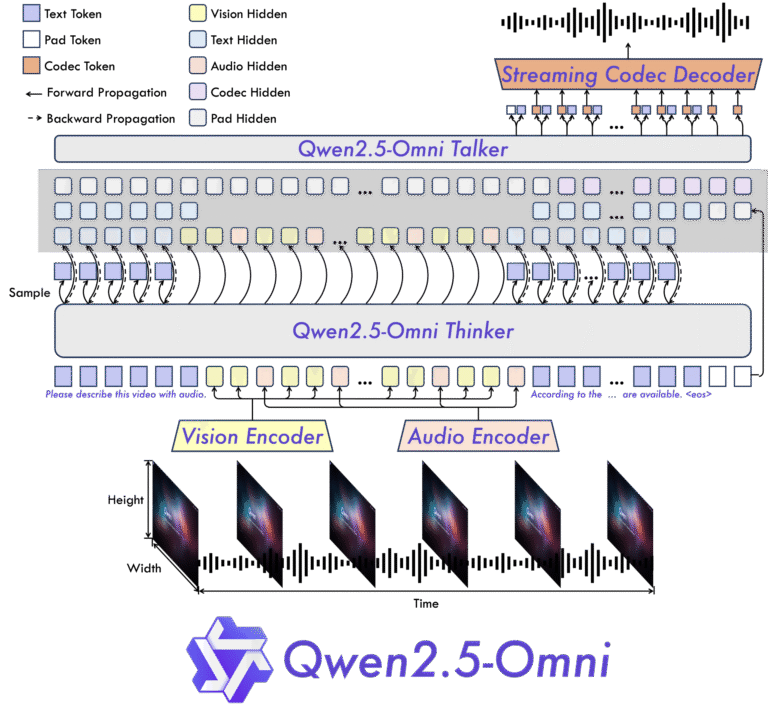
Multimodal AI on Developer GPUs: Alibaba Releases Qwen2.5-Omni-3B with 50% Lower VRAM Usage and Nearly-7B Model Performance

Multimodal foundation models have shown substantial promise in enabling systems that can reason across text, images, audio, and video. However, the practical deployment of such models is frequently hindered by hardware constraints. High memory consumption, large parameter counts, and reliance…

Read MoreMultimodal AI on Developer GPUs: Alibaba Releases Qwen2.5-Omni-3B with 50% Lower VRAM Usage and Nearly-7B Model Performance

Exploring the Sparse Frontier: How Researchers from Edinburgh, Cohere, and Meta Are Rethinking Attention Mechanisms for Long-Context LLMs

Sparse attention is emerging as a compelling approach to improve the ability of Transformer-based LLMs to handle long sequences. This is particularly important because the standard self-attention mechanism, central to LLMs, scales poorly with sequence length—its computational cost grows quadratically…

Read MoreExploring the Sparse Frontier: How Researchers from Edinburgh, Cohere, and Meta Are Rethinking Attention Mechanisms for Long-Context LLMs

Mem0: A Scalable Memory Architecture Enabling Persistent, Structured Recall for Long-Term AI Conversations Across Sessions

Large language models can generate fluent responses, emulate tone, and even follow complex instructions; however, they struggle to retain information across multiple sessions. This limitation becomes more pressing as LLMs are integrated into applications that require long-term engagement, such as…

Read MoreMem0: A Scalable Memory Architecture Enabling Persistent, Structured Recall for Long-Term AI Conversations Across Sessions

Diagnosing and Self- Correcting LLM Agent Failures: A Technical Deep Dive into τ-Bench Findings with Atla’s EvalToolbox

Deploying large language model (LLM)-based agents in production settings often reveals critical reliability issues. Accurately identifying the causes of agent failures and implementing proactive self-correction mechanisms is essential. Recent analysis by Atla on the publicly available τ-Bench benchmark provides granular…

Read MoreDiagnosing and Self- Correcting LLM Agent Failures: A Technical Deep Dive into τ-Bench Findings with Atla’s EvalToolbox